- Previous best
- 2.635983
- EvoDuet
- 2.635983
- Objective
- Sum of radii ↑
- Run cost
- $36.33
Source
Python
# EVOLVE-BLOCK-START
"""Numerically optimized variable-radius packing of 26 circles."""
import numpy as np
from scipy.optimize import minimize, linprog


def _make_start(seed):
    """Build varied five- or six-row center layouts for LP/SLP polishing."""
    rng = np.random.default_rng(seed)
    patterns = (
        (4, 4, 5, 4, 5, 4),
        (5, 4, 4, 5, 4, 4),
        (4, 5, 4, 5, 4, 4),
        (4, 5, 5, 4, 4, 4),
        (5, 4, 5, 4, 4, 4),
        (4, 4, 4, 5, 4, 5),
        (4, 5, 4, 4, 5, 4),
        (5, 4, 4, 4, 5, 4),
        (4, 4, 5, 5, 4, 4),
        (5, 4, 5, 4, 4, 4),
        (4, 5, 4, 4, 4, 5),
        (5, 4, 4, 4, 4, 5),
    )
    counts = patterns[seed % len(patterns)]
    rows = len(counts)
    heights = np.ones(rows) / rows
    heights += rng.normal(0.0, 0.012, rows)
    heights = np.maximum(heights, 0.13)
    heights /= np.sum(heights)
    levels = np.cumsum(np.r_[0.0, heights[:-1]])
    p = []
    for row, count in enumerate(counts):
        y = levels[row] + 0.5 * heights[row]
        xs = (np.arange(count) + 0.5) / count
        phase = rng.uniform(-0.055, 0.055)
        xs = xs + phase + rng.normal(0.0, 0.004, count)
        p.extend((x, y) for x in xs)
    p = np.asarray(p[:26], dtype=float)
    p += rng.normal(0.0, 0.004, p.shape)
    p = np.clip(p, 0.055, 0.945)
    return np.column_stack((p, np.full(26, 0.043)))


def _constraints(z):
    """Return wall-clearance and pairwise non-overlap inequalities."""
    q = z.reshape(26, 3)
    x, y, r = q.T
    out = [x - r, y - r, 1.0 - x - r, 1.0 - y - r]
    for i in range(25):
        d = q[i + 1:, :2] - q[i, :2]
        out.append(np.sum(d * d, axis=1) - (r[i] + r[i + 1:]) ** 2)
    return np.concatenate(out)


def _repair(q):
    """Shrink radii uniformly until every wall and pair constraint is strict."""
    q = np.asarray(q, dtype=float).copy()
    q[:, :2] = np.clip(q[:, :2], 1e-5, 1.0 - 1e-5)
    q[:, 2] = np.maximum(q[:, 2], 0.0)
    q[:, 2] = np.minimum(q[:, 2],
                         np.minimum.reduce((q[:, 0], q[:, 1],
                                             1.0 - q[:, 0], 1.0 - q[:, 1])))
    factor = 1.0
    for i in range(25):
        d = np.sqrt(np.sum((q[i + 1:, :2] - q[i, :2]) ** 2, axis=1))
        s = q[i, 2] + q[i + 1:, 2]
        mask = s > 0
        if np.any(mask):
            factor = min(factor, float(np.min(d[mask] / s[mask])))
    # Keep only a tiny numerical safety margin; the previous 0.05% shrink
    # discarded a measurable amount of objective value on every polish.
    q[:, 2] *= max(0.0, min(1.0, factor * 0.999999))
    return q


def construct_circles():
    """Use feasible LP radii followed by inner linearized center/radius polishing."""
    n = 26
    best = None
    best_value = -1.0
    # Preserve distinct feasible active sets: the LP ranking is not always
    # the same as the ranking after exact nonlinear optimization.
    elite = []

    def polish(q):
        """Maximize radii through monotone LP steps with bounded center moves."""
        q = np.asarray(q, dtype=float).copy()
        x, y = q[:, 0], q[:, 1]

        # First maximize the radii exactly for the fixed starting centers.
        ar = []
        br = []
        for i in range(n):
            row = np.zeros(n)
            row[i] = 1.0
            ar.append(row)
            br.append(min(x[i], y[i], 1.0 - x[i], 1.0 - y[i]))
        for i in range(n - 1):
            for j in range(i + 1, n):
                row = np.zeros(n)
                row[i] = row[j] = 1.0
                ar.append(row)
                br.append(np.hypot(x[i] - x[j], y[i] - y[j]))
        lp = linprog(
            np.full(n, -1.0),
            A_ub=np.asarray(ar),
            b_ub=np.asarray(br),
            bounds=[(0.0, 0.5)] * n,
            method="highs",
        )
        if not lp.success:
            return _repair(q)
        q[:, 2] = lp.x

        # Each LP below is an inner approximation: its solution remains
        # feasible for the nonlinear distance constraints.
        for trust in (0.028, 0.018, 0.010, 0.005, 0.002):
            for _ in range(18):
                x, y, r = q.T
                nv = 3 * n
                aa = []
                bb = []

                for i in range(n):
                    row = np.zeros(nv)
                    row[3 * i] = -1.0
                    row[3 * i + 2] = 1.0
                    aa.append(row)
                    bb.append(x[i] - r[i])

                    row = np.zeros(nv)
                    row[3 * i + 1] = -1.0
                    row[3 * i + 2] = 1.0
                    aa.append(row)
                    bb.append(y[i] - r[i])

                    row = np.zeros(nv)
                    row[3 * i] = 1.0
                    row[3 * i + 2] = 1.0
                    aa.append(row)
                    bb.append(1.0 - x[i] - r[i])

                    row = np.zeros(nv)
                    row[3 * i + 1] = 1.0
                    row[3 * i + 2] = 1.0
                    aa.append(row)
                    bb.append(1.0 - y[i] - r[i])

                for i in range(n - 1):
                    for j in range(i + 1, n):
                        dx = x[i] - x[j]
                        dy = y[i] - y[j]
                        d = np.hypot(dx, dy)
                        if d < 1e-10:
                            continue
                        ux, uy = dx / d, dy / d
                        row = np.zeros(nv)
                        row[3 * i] = -ux
                        row[3 * i + 1] = -uy
                        row[3 * j] = ux
                        row[3 * j + 1] = uy
                        row[3 * i + 2] = row[3 * j + 2] = 1.0
                        aa.append(row)
                        bb.append(d - r[i] - r[j])

                bounds = []
                for i in range(n):
                    bounds.extend([
                        (-trust, trust), (-trust, trust), (-r[i], 0.12)
                    ])
                step = linprog(
                    np.array([0.0, 0.0, -1.0] * n),
                    A_ub=np.asarray(aa),
                    b_ub=np.asarray(bb),
                    bounds=bounds,
                    method="highs",
                )
                if not step.success or np.max(np.abs(step.x)) < 1e-9:
                    break
                q += step.x.reshape(n, 3)

        return _repair(q)

    for seed in range(120):
        q = polish(_make_start(seed))
        value = float(np.sum(q[:, 2]))
        if np.all(_constraints(q) >= -2e-8):
            elite.append((value, q.copy()))
            if value > best_value:
                best, best_value = q, value

    # Keep a broad but bounded set of candidates for later exact polishing.
    elite.sort(key=lambda item: item[0], reverse=True)
    elite = elite[:24]

    def nonlinear_polish(q):
        """Refine a feasible packing with SLSQP on exact nonlinear constraints."""
        q = np.asarray(q, dtype=float).copy()
        nvar = 3 * n

        def objective(z):
            return -float(np.sum(z[2::3]))

        def objective_jac(z):
            g = np.zeros(nvar)
            g[2::3] = -1.0
            return g

        result = minimize(
            objective,
            q.ravel(),
            jac=objective_jac,
            method="SLSQP",
            bounds=[(0.0, 1.0), (0.0, 1.0), (0.0, 0.2)] * n,
            constraints={"type": "ineq", "fun": _constraints},
            options={
                "ftol": 2e-11,
                "maxiter": 500,
                "disp": False,
            },
        )
        if result.success or np.all(_constraints(result.x) >= -2e-8):
            candidate = result.x.reshape(n, 3)
            if np.all(_constraints(candidate) >= -2e-8):
                return candidate
        return q

    if best is None:
        best = _repair(_make_start(0))

    # Exact SLSQP polishing can change the contact graph and therefore can
    # reorder candidates that looked similar under the LP inner model.
    # Polish several geometrically distinct layouts before basin hopping.
    refined_count = 0
    seen = []
    for _, candidate in elite:
        signature = np.round(candidate[:, :2], 5)
        if any(np.max(np.abs(signature - old)) < 1e-10 for old in seen):
            continue
        seen.append(signature)
        refined = nonlinear_polish(candidate)
        if (
            np.all(_constraints(refined) >= -2e-8)
            and np.sum(refined[:, 2]) > best_value + 1e-11
        ):
            best = refined
            best_value = float(np.sum(refined[:, 2]))
        refined_count += 1
        if refined_count >= 12:
            break

    # Explore nearby basins using coherent affine deformations.  Moving all
    # centers together is substantially safer than independently jittering
    # circles in a jammed packing, and the subsequent LP/SLP polish restores
    # feasible radii while optimizing the deformed layout.
    rng = np.random.default_rng(918273)
    incumbent = best.copy()
    incumbent_value = float(np.sum(incumbent[:, 2]))
    walker = incumbent.copy()
    walker_value = incumbent_value

    # Use threshold acceptance rather than strict hill climbing.  This lets
    # the center deformation cross shallow local-optimum barriers, while the
    # separate incumbent remains strictly monotone.
    for trial in range(140):
        # Occasionally restart the walk from a different elite contact graph
        # instead of repeatedly perturbing one basin.
        if trial % 19 == 0 and len(elite) > 1:
            idx = int(rng.integers(0, min(12, len(elite))))
            q = elite[idx][1].copy()
        else:
            q = walker.copy()
        c = q[:, :2] - 0.5

        angle = rng.normal(0.0, 0.040)
        ca, sa = np.cos(angle), np.sin(angle)
        sx = rng.uniform(0.93, 1.09)
        sy = rng.uniform(0.93, 1.09)
        shear = rng.normal(0.0, 0.055)
        transform = np.array([
            [sx * ca, -sy * sa + shear],
            [sx * sa,  sy * ca],
        ])
        q[:, :2] = 0.5 + c @ transform.T

        # Apply small coherent row waves to alter the active contact graph
        # while retaining the useful six-row arrangement.
        if trial % 3 == 1:
            rows = np.clip(np.floor(q[:, 1] * 6.0).astype(int), 0, 5)
            phase = rng.uniform(0.0, 2.0 * np.pi)
            wave = rng.normal(0.0, 0.0055, 6)
            q[:, 1] += wave[rows]
            q[:, 0] += 0.0035 * np.sin(1.6 * rows + phase)

        # Alternate collective and weak individual perturbations so that the
        # walk can both change row geometry and break repeated contacts.
        if trial % 2 == 0:
            q[:, :2] += rng.normal(0.0, 0.0038, (n, 2))
        if trial % 7 == 6:
            q[:, :2] += rng.normal(0.0, 0.0018, (n, 2))

        q = polish(_repair(q))
        if not np.all(_constraints(q) >= -2e-8):
            continue
        value = float(np.sum(q[:, 2]))
        elite.append((value, q.copy()))
        if len(elite) > 32:
            elite.sort(key=lambda item: item[0], reverse=True)
            elite = elite[:24]

        # Geometrically cool the acceptance band, then restart it.  The
        # threshold is deliberately small relative to the incumbent margin.
        phase = trial % 14
        temperature = 0.00055 * (0.18 ** (phase / 13.0))
        if value >= walker_value - temperature:
            walker, walker_value = q, value

        if value > incumbent_value:
            incumbent, incumbent_value = q, value
            best, best_value = q, value

        # Prevent a sequence of accepted downhill moves from abandoning the
        # best basin family altogether.
        if walker_value < incumbent_value - 0.003:
            walker = incumbent.copy()
            walker_value = incumbent_value

    # The LP iterations use tangent half-spaces, so they can stop at a
    # nonsmooth active-set point.  SLSQP can jointly adjust centers and
    # radii across the exact circular constraints.
    refined = nonlinear_polish(best)
    if (
        np.all(_constraints(refined) >= -2e-8)
        and np.sum(refined[:, 2]) > np.sum(best[:, 2])
    ):
        best = refined

    return best


# EVOLVE-BLOCK-END


# This part remains fixed (not evolved)
def run_code():
    """Run the circle packing constructor for n=26"""
    circles = construct_circles()
    sum_radii = float(np.sum(circles[:, 2]))
    return circles, sum_radii
Requires the original benchmark harness and dependencies.
Score history 100 iterations
Score history
Best-so-far search-time score ↑ · each new best is colored by that iteration’s gate decision
Search-time scores; the final native objective is reported above.
Run details
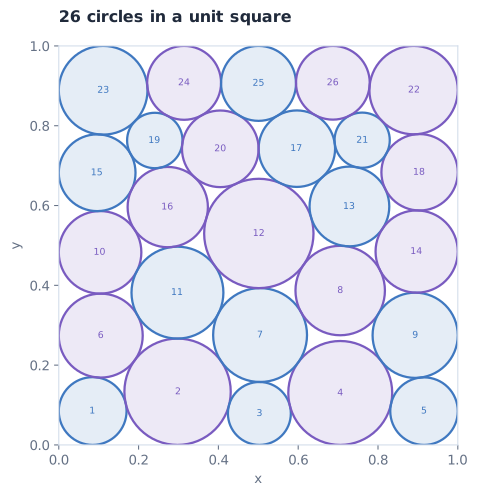
A variable-radius packing optimized with linearized steps, local exploration, and nonlinear polishing.
Circle coordinates are a fresh replay of the archived source. Boundary and pairwise non-overlap constraints were checked.
Recorded score: 2.6359830849184607 · reference: 2.6359830849210715 · seed: 42.
Replay sum of radii: 2.635983084918. Positive radii, square boundaries, and pairwise non-overlap verified for all 26 circles.
Program ID: f88acdcb-13db-49ab-8e7f-b8f48c31ef2e
Source SHA-256: fbb63f8de368e82f63089f865b3d9769db5eb44970613c5d396bf86c5335a251
History SHA-256: f9f4fe28f0ea5ae0a0273f74d5a987a8a4794eea806496c4707e2fbf95393478